Portraits of artists upon entering their residency, and VR portraits at their end-of-residency exhibitions.
In collaboration with the association les Écluses de l’Art.
2026
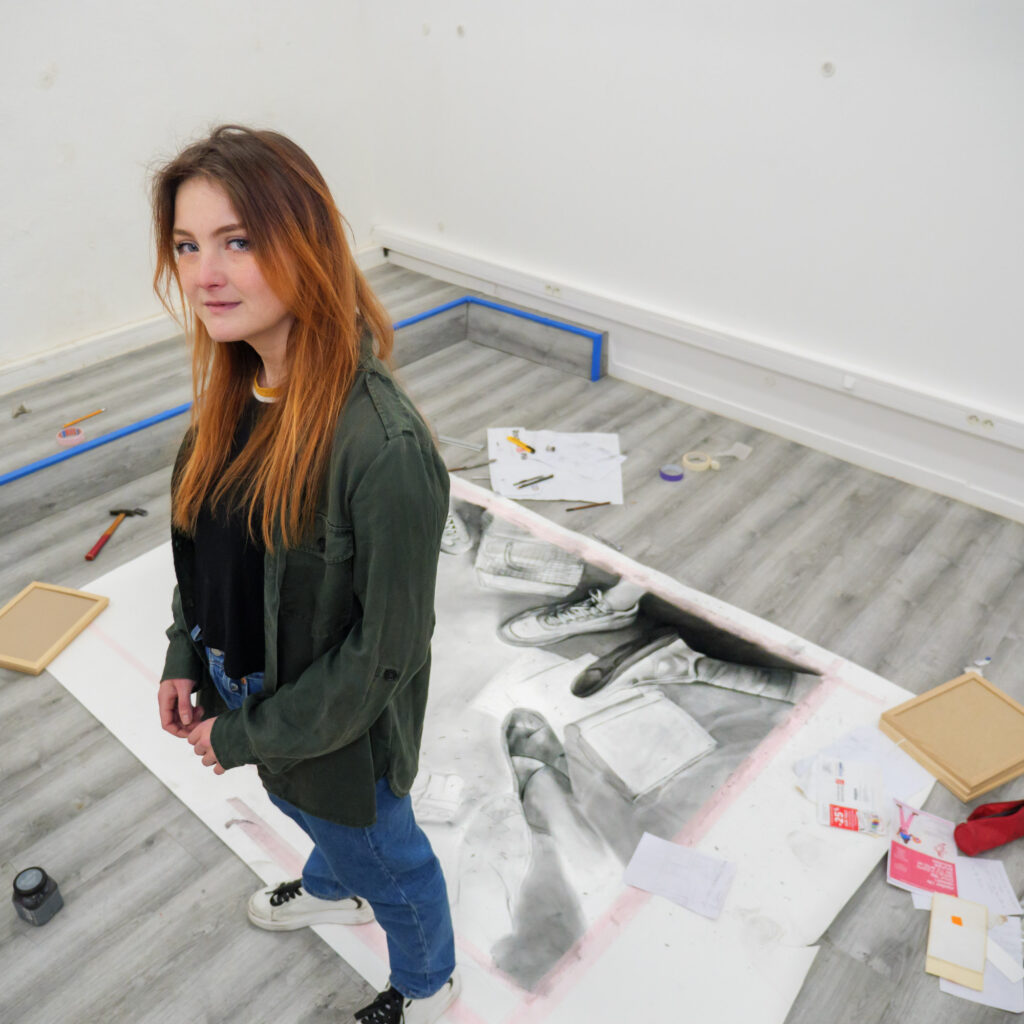
Marine Gambardella is a visual artist based in Nice. She works in charcoal and black stone drawing. During a three week residency at the Maison Relin, she stayed at the Villa Antonine, whose garden seeped into her work. Bodies in charcoal, hands, imprints set within a living space.
For the residency's open studio, she set up a small sitting room in the Maison Relin exhibition space: three armchairs around a low table. An invitation to wander, or perhaps to sit down and look differently. In 360°, she occupies all three armchairs at once.
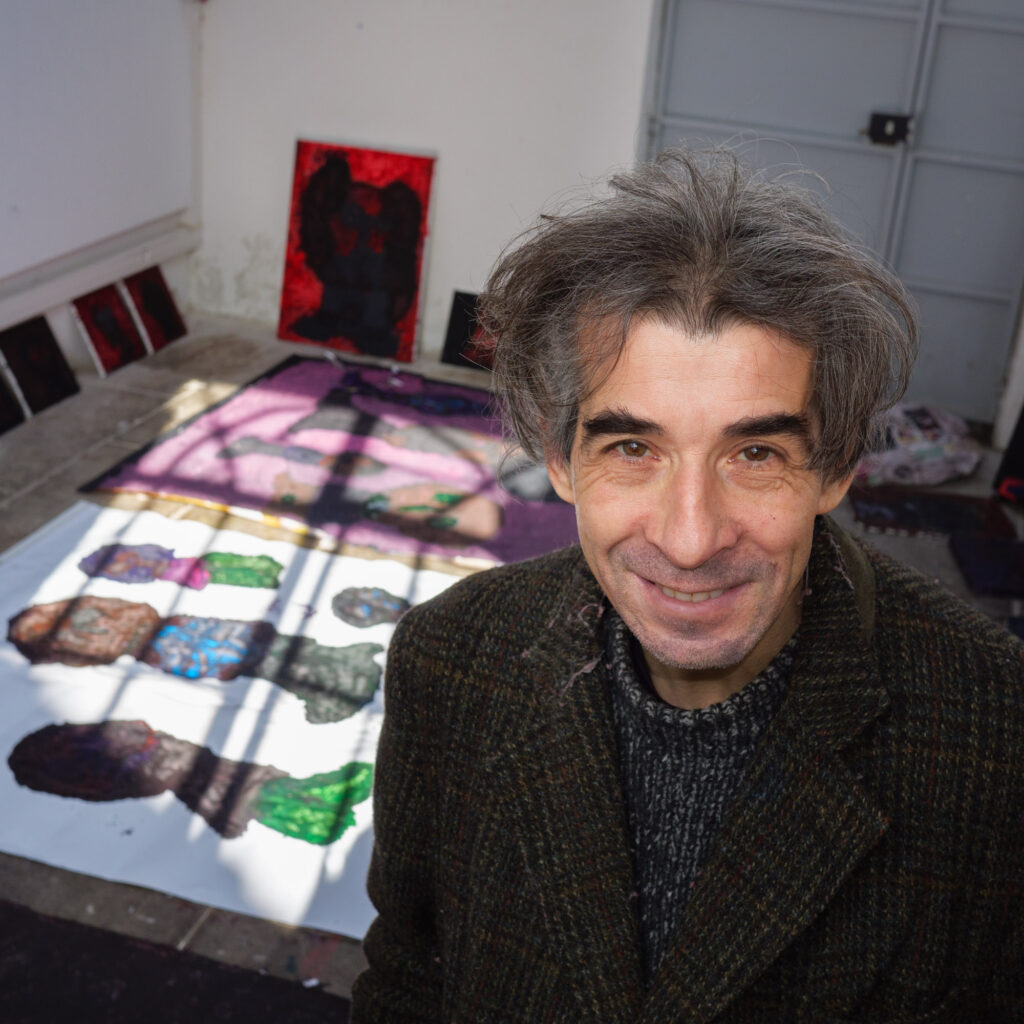
Alexis Vicente, an outsider artist (art brut), usually develops work combining painting, sculpture and assemblage. For this residency at the Villa Antonine, he chose to focus on painting.
This exhibition presents all the works created during his three months of residency.

After two months in residence at Villa Antonine, artists Colette Schultz and Tian Jin present the fruits of their work in an end-of-residency exhibition open to the public. Their joint project grew out of a dialogue between practices, cultures and sensibilities. Both explore memory, time and landscape, weaving together references drawn from painting, narrative and fragmented imagery.
Colette Schultz develops a body of work at the intersection of painting and comics. Trained in Chinese painting during a stay in Hangzhou, she draws from it a relationship to gesture, emptiness and slowness, which she brings into dialogue with her taste for narrative, framing and sequence. In Béziers and across the wider Occitanie region, she works through walking, observation and listening. Her images oscillate between the everyday and the dreamlike, between contemplation and narration, forming a constellation of fragments inspired by the light of the South, its landscapes, historical layers and the poetic resonances of the territory.
Tian Jin, painter and video artist trained at the China Academy of Art and ENSAPC, develops a practice centred on what he calls "temporal fragments". His works draw from moments of life, landscapes passed through and places marked by history. During this residency he explores through painting how time, memory and ruins intertwine, setting past and present in dialogue in a sensitive and fragmentary approach to history.
The exhibition brings together paintings and visual fragments that echo one another, tracing a poetic geography between two cultures. The end-of-residency show is an opportunity to discover a work in progress, born from an immersion in the Béziers territory and the dialogue between the two artists.
2025

Lucas Zambon Les Daurades de la Piscine Municipale
His work falls within a multidisciplinary approach blending photography, painting, writing, video and installation. At the boundaries of mediums, he develops narratives and devices where images, objects and words enter into dialogue to explore the limits of the visible.
At the close of his residency, the artist offered a public reading from his exhibition-novel, currently being written, accompanied by printed pages presented as fragments of the project. This restitution moment brings to light a multidisciplinary practice blending writing, image and installation, where reality tips into the absurd, the poetic and the ironic, and where narratives are built at the boundaries of the visible.

Antoine Borromée Dubois Collision
This exhibition closes a year-long residency devoted to an intimate and visual inquiry into the figure of Maurice Dubois, the artist's grandfather, who died in 1953 in a sudden accident. Drawing from family memories, photographic archives and accounts passed down by the last person still alive to have known him, the project examines how an absence can travel through time and shape lives.

This exhibition closes a year-long residency devoted to a reflection on the human figure in the face of contemporary scientific, technological and environmental shifts. Drawing on his expertise in paleoanthropological reconstruction, the artist develops a visual practice that questions the future of bodies, identity and appearance in a world where self-transformation is becoming the norm.
Between science, fiction and sculpture, the works on show compose a landscape of possible bodies, situated at the crossroads of the pre-human, the post-human and life in mutation. The exhibition offers a journey through a future in gestation, where the body becomes a malleable material, revealing at once our desires for adaptation and the limits of these projections.

The artist defines herself as an "ecollagist" — a term she has coined to describe her practice. She creates her works from flyers, newspapers and magazines, repurposing advertising imagery to compose landscapes and natural scenes. At first glance, the works evoke painting. Gradually, fragments, signs and traces of their printed origins surface, revealing another layer of reading.
The project was built from a sensitive exploration of the territory, its landscapes, flora and fauna. Photographs, drawings and watercolours made on location then feed into a lengthy process of cutting and assembling. Through large-format works, sometimes conceived as diptychs or triptychs, collage becomes a space of transformation, where ordinary and polluting materials are recomposed to bring forth a reinvented nature — at once immersive and fragile.

Poctlii comes from Mexico, and during his residency he created a body of work that sets his research on the Nahua peoples in dialogue with visuals drawn from his time in Béziers.
Il utilise ses recherches sur les cultures mésoaméricaines pour remplacer ou combiner les matériaux et techniques anciennes avec des méthodes et une esthétique contemporaines. Il emploie la fusion de techniques européennes comme la peinture à l’huile, ou ici acrylique, pour exprimer des thèmes liés à la perte de la culture précoloniale et à la diffusion des cultures mésoaméricaines.

Lola Rodriguez Tendre Usure
At the crossroads of installation, textile, sound and scent, Tendre Usure explores the ties between attachment, memory and vulnerability. Developed during the residency, the project draws on the presence of comfort objects — intimate things laden with repeated gestures, blurred memories and buried tenderness. Tendre Usure explore les liens entre attachement, mémoire et vulnérabilité. Développé au cours de la résidence, le projet s’appuie sur la présence des doudous, objets intimes chargés de gestes répétés, de souvenirs flous et de tendresses enfouies.
Through worn, familiar, sometimes wounded materials, the artist questions what survives of childhood in our adult lives, what resists and continues to heal. The project gave rise to several installations as well as a paper edition combining testimonies, a hybrid essay and an artist's book.

Patricia Dubois Nous Sommes Nature
This project explores a painting practice situated between figuration and Color Field Painting. Through a series of small-format portraits, the artist stages individuals mimicking elements of nature. Each canvas is painted in monochrome, using a single colour, in order to explore the expressive possibilities of colour in dialogue with the human figure. Colorfield Painting. À travers une série de portraits de petit format, l’artiste met en scène des personnes mimant des éléments de la nature. Chaque toile est réalisée en camaïeu d’une seule couleur, afin d’explorer les possibilités expressives de la couleur en dialogue avec la figure humaine.
Born from an open call, the project draws on photographs sent in by participants. "Through this approach, I wish to stimulate empathy, the act of putting oneself in the place of… How does it feel to be in the skin of a tree, a cloud, an animal?"
Araceli Villar Inmersión
Inmersión is an exhibition born from six months of residency at Villa Antonine. Conceived as a tribute to Mediterranean folk art, it offers a sensory journey through forms, patterns and influences tied to this territory, between personal immersion and collective resonances.
Théo Michel alias TO_LapsDes Liens Gravés
This residency project is rooted in a research into memory, artistic heritage and the ways in which narratives are transmitted and transformed over time. Taking as anchor points the two cities where he grew up and studied, Béziers and Angers, the artist explores the historical and symbolic ties that connect these territories.
Through a process of heritage and iconographic research, he uncovers correspondences between several major figures of the 19th and 20th centuries, notably the Béziers sculptor Antonin Injalbert, the statuary David d'Angers and the painter Jules-Eugène Lenepveu. Archives, anecdotes and documents become working material that he reinterprets through a contemporary approach.
His visual practice rests on an almost archaeological approach to the image. Photographs, drawings and documents are reworked, simplified, then engraved onto glass or locally collected materials. These gestures establish bridges between past and present, between official history and felt memory, and offer a renewed reading of the works and the territories they traverse.